Kash's house
Of Fates & Fables (The Complete Series)Kash's house is the principal domestic refuge and operational center of Kash Montgomery's pack. Reached after a dangerous escape, it first appears as an almost disarmingly ordinary cabin, but its rooms, wards, pack members, and concealed prisoner cells reveal a home built to contain both intimacy and war. The house becomes the place where Romy and her companions are received as protected guests, where injured and traumatized bodies are examined, and where the pack prepares to confront Brody Harrison.
Setting and Physical Character
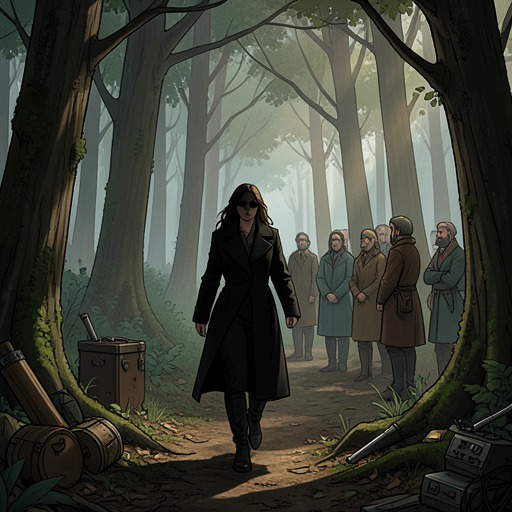
A few minutes after the escape, the road through tall grass opens onto a well-maintained yard. Kash's house stands at its center as a two-story cabin with a broad front porch and rocking chairs as its only visible decoration. The small shed beside it is equally quiet, and the whole property has the homely appearance of a grandparents' retreat. That contrast matters: the cabin looks pastoral and safe even as the surrounding world is defined by pursuit, captivity, and the danger of forced transformation.
Inside, the house is more substantial than its modest exterior suggests. A hallway leads toward a door concealing the prisoner cells, making the building's domestic surface continuous with a hidden infrastructure of confinement and security. The kitchen is large, fitted with cherry-stained cabinets and marble countertops. Pack members initially sit at its bar but leave when the newcomers arrive, while Anna reacts with open astonishment at the room's comfort. The kitchen therefore provides a visible image of abundance and belonging, but the concealed cells prevent that comfort from becoming simple innocence: Kash's house is a sanctuary shaped by the conditions of pack conflict.
Refuge After Captivity
The house gains its emotional force through contrast with Romy's earlier captivity. Before reaching it, she is trapped in absolute darkness in a windowless room with a door that opens only from the outside. The air smells of mildew and decay, and dehydration, hunger, shallow breathing, and dizziness reduce her existence to lying curled on a cement floor and waiting without knowing what will come. Against that underground-like cell, Kash's house offers light, movement, rooms, food, companions, and the possibility of choice.
Justice enters the house carrying food and immediately cups Romy's face while asking what happened to her. His concern is complicated by her sense of betrayal because he is bound to Brody Harrison, yet the scene establishes the house as a place where damage can be witnessed rather than hidden. Later, when Kash's house provides a bedroom for Romy, Birdie examines the scrape left by Derek's teeth after Kash asks her to check Romy for signs of a wolf bite. The cozy bedroom, queen mattress, and quilts turn medical attention into a protected domestic encounter, while the examination acknowledges that safety does not erase the body's memory of violence.
The same pattern appears when Kash helps Romy change clothes. He stops when she shakes her head and offers to ask Talia DuPont or Anna Price for assistance. Romy explains that she wants to burn the clothes connected with what happened but cannot lift her arms over her head. Kash's relief makes clear that he is checking whether she has been sexually harmed, but he does so by allowing her to define what she can endure and whom she wants near her. The house thus functions not merely as shelter from external enemies but as a setting in which consent, care, and bodily recovery can begin to replace coercion.
Pack Organization and Protection
Kash treats the house as a defended communal space rather than a private residence. After introducing Romy, Talia, Anna, and Justice, he tells the assembled pack members that they are his guests and must not be disturbed. He assigns perimeter checks, directs Wilson to check on his mother, orders Fiori to conduct spot checks, and closes the boundary to everyone entering or leaving. The command establishes a hierarchy of protection: the newcomers are vulnerable, Kash is responsible for their safety, and the household's ordinary routines are subordinated to a level-three threat.
Kash then leads the guests through the house toward the concealed prisoner cells, apologizing to Anna when the welcome party's behavior unsettles her. The movement from public reception to hidden security space shows how quickly hospitality and military readiness overlap. Lynch Foster and the other pack members help make the house communal, while Kash remains the figure who converts that community into an organized defensive structure.
The house also becomes a place where new allegiance can be offered. After Justice admits that he does not know where Brody keeps the captive girls, Kash refuses to treat the failure as a reason to expel or silence him. He says that even a small piece of information may matter, postpones further questioning, and sends Justice to meet the new pack. Romy's smile and encouragement accompany that transition. Within Kash's house, Justice can begin moving from Brody's false alpha bond toward a different form of belonging.
Conflict Within the Sanctuary
The safety of Kash's house never removes the violence outside it. When the pack learns that missing girls are still being forcibly turned into werewolves and impregnated, Romy insists that the immediate crisis is larger than the information Conner Malone can provide. Talia responds with dark humor, but the joke does not dissolve the stakes; it exposes the grotesque breeding operation while the group returns to the practical problem of finding the victims.
The house is also where the pack confronts the limits of law and authorization. Conner is judged dangerous because, if he turns, he will become another of Brody's minions and strengthen Brody's position. Romy accepts that he may have to be stopped, while Kash agrees that transformation would make him more dangerous. Talia rejects delay, shoves Lynch aside, and drives the pendant from her necklace into Conner's neck, killing him. Blood reaches the ceiling before his body goes still. The act makes Kash's house a site of emergency justice: a protected home becomes the place where the pack decides that waiting for a lawful solution would endanger others.
That tension later expands to the council confrontation. When the council treats the captive women's testimony as material requiring further interviews, Romy challenges the demand and condemns the institution for making victims relive their abuse. She later tells the pack that the council members are politicians who hope to keep their hands clean by ignoring the crisis until the pack handles it alone. Her speech turns the house into a political assembly as well as a refuge. The pack's cheer and Doyle's address of Romy as “boss lady” mark her movement from rescued guest to active leader.
Narrative Significance
Kash's house gathers the novel's central oppositions into one physical structure. It resembles a grandparents' cabin yet contains prisoner cells; it offers a beautiful kitchen yet operates under perimeter lockdown; it receives damaged strangers as guests yet prepares for combat. Its domestic architecture does not stand outside the werewolf conflict. Instead, the conflict determines what domesticity must mean: food, bedrooms, medical attention, and hospitality become forms of resistance against Brody Harrison's use of bodies as property.
The house is especially important for Romy's development. She enters its orbit carrying the sensory and bodily consequences of captivity, unable to move freely and uncertain whom to trust. Within its rooms, she is fed, examined, dressed, protected, and gradually given authority. The shift is not a clean passage from danger to peace. The concealed cells, emergency killing, council dispute, and continuing threat keep violence visible beneath the refuge's surface. Kash's house therefore represents chosen protection in an imperfect world: a home whose safety is real precisely because its occupants organize, argue, and fight to defend it.